Generator
Algorithm
The generator conceptual workflow is show below:
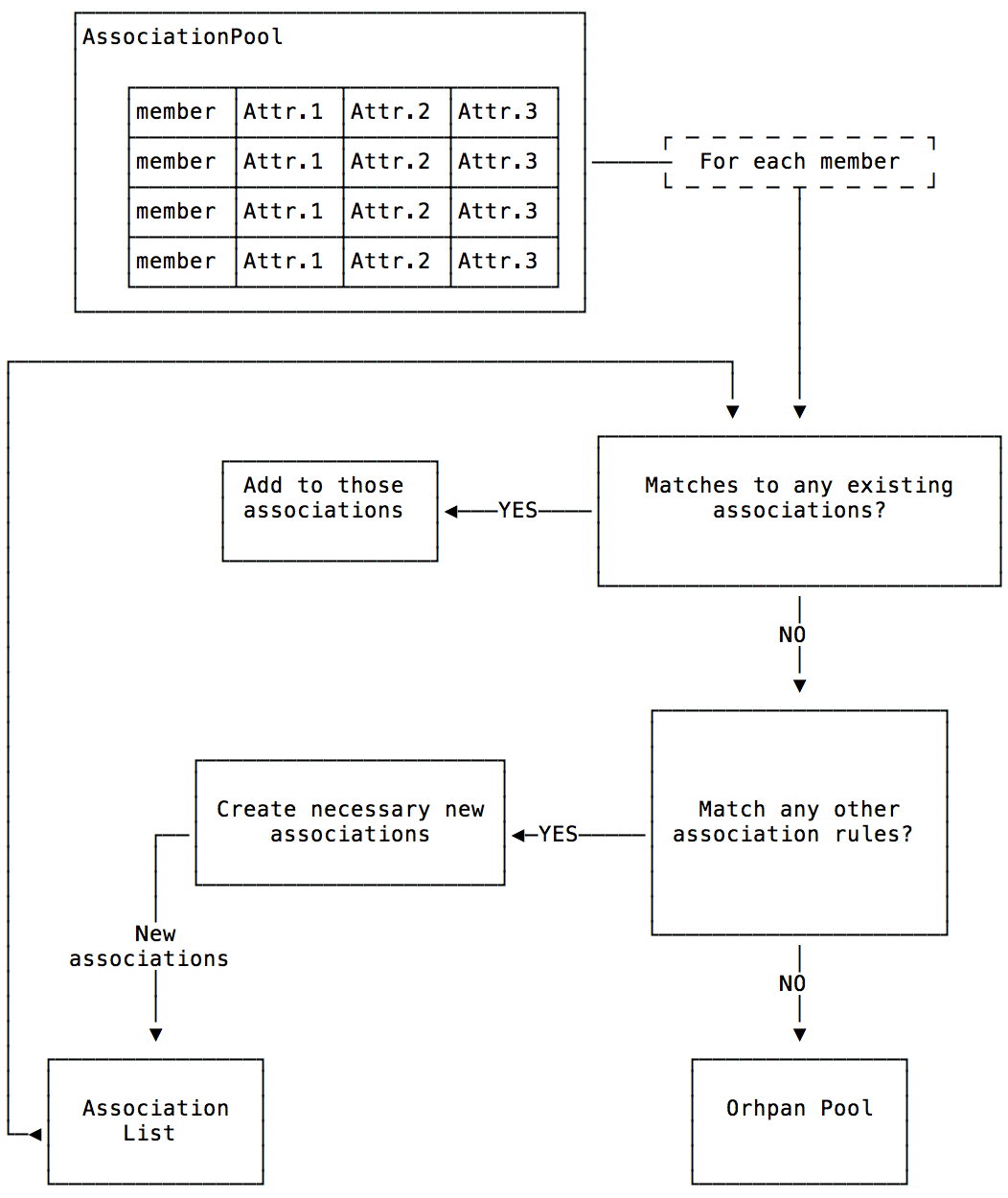
Figure 1: Generator Conceptual Workflow
This workflow is encapsulated in the generate. Each member is first checked to see if it belongs to an already existing association. If so, it is added to each association it matches with. Next, the set of association rules are check to see if a new association, or associations, are created by the member. However, only associations that have not already been created are checked for. This is to prevent cyclical creation of associations.
As discussed in Associations and Rules, associations are Python
classes, often referred to as association rules, and their
instantiations, referred to as associations. An association is
created by calling the Association.create class method for each
association rule. If the member matches the rule, an association is
returned. Each defined rule tried. This process of checking whether a
member would create any associations is encapsulated in the
AssociationRegistry.match method
Conversely, to see if a member belongs to an already existing
association, an attempt is made to add the member using the
Association.add method. If the
addition succeeds, the member has been added to the association
instance. The generator uses match_member function to loop through
its list of existing associations.
Output
Before exiting, the generate checks the Association.is_valid property of each
association to ensure that an association has all the members it is
required to have. With respect to JWST and Level3 processing, an
example of an association that would not be valid would be if an
observation failed to complete, producing only a subset of exposures.
The result would be an invalid association, since any further
processing would fail.
Once validation is complete, generate returns a 2-tuple. The first item is a list of the associations created. The second item is another AssociationPool containing all the members that did not get added to any association.
Member Attributes that are Lists
As mentioned in Association Pool, most member attributes are simply treated as strings. The exception is when an attribute value looks like a list:
[element, ...]
When this is the case, a mini pool is created. This pool consists of duplicates of the original member. However, for each copy of the member, the attribute that was the list is now populated with consecutive members of that list. This mini pool and the rule or association in which this was found, is passed back up to the generate function to be reconsidered for membership. Each value of the list is considered separately because association membership may depend on what those individual values are. The figure below demonstrates the member replication.
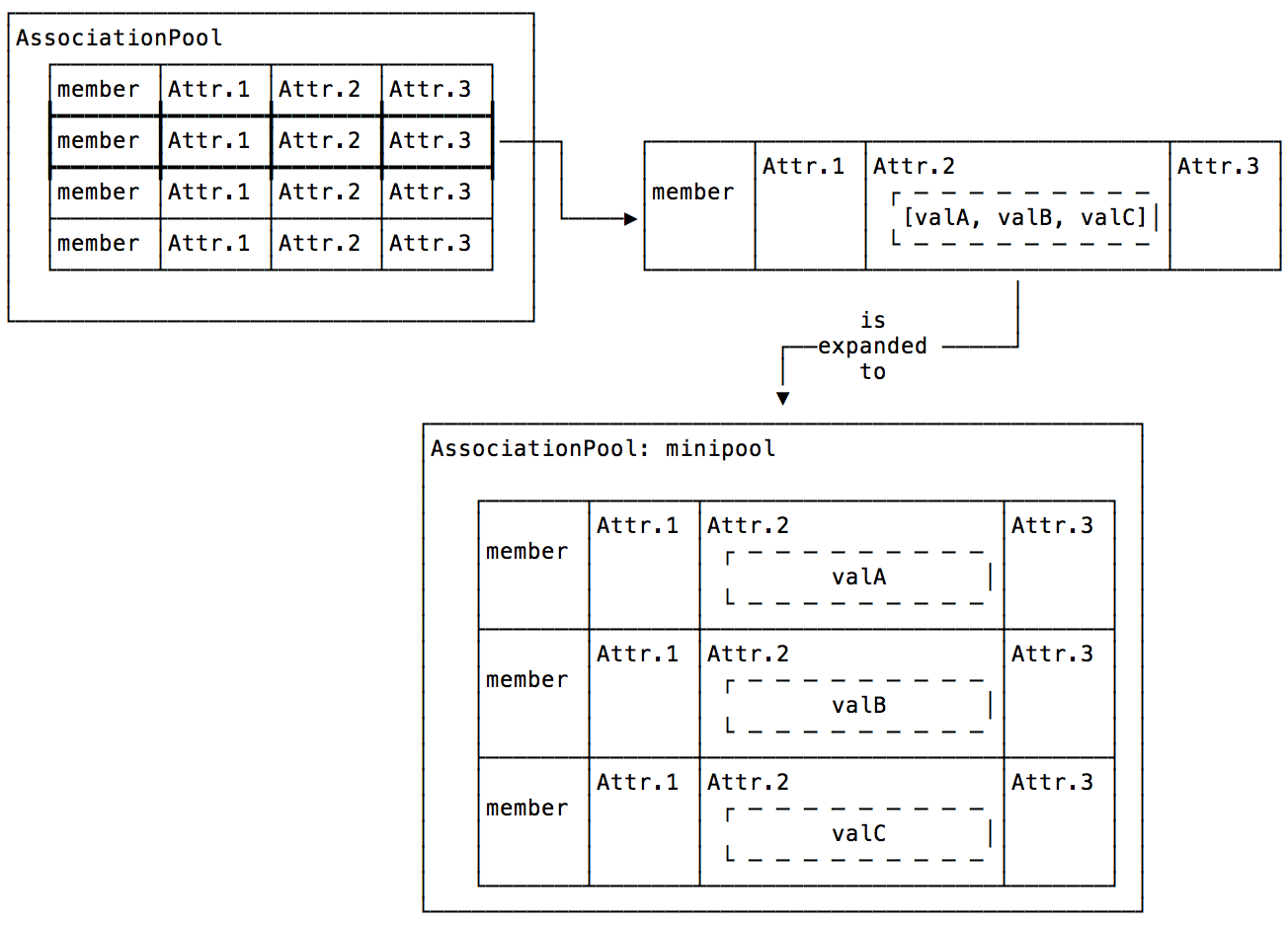
Figure 2: Member list expansion
For JWST, this is used to filter through the various types of association candidates. Since an exposure can belong to more than one association candidate, the exposure can belong to different associations depending on the candidates.
Association Candidates
TBD